 ZecZcash
· 19 min read
Zcash ETF (ZCSH): The Complete History and How It Works
Yes — there is a Zcash exchange-traded product in the United States.
The Zcash ETF (NYSE Arca: ZCSH), sponsored by Grayscale, holds ZEC directly and lets investors get exposure to Zcash's price through an ordinary brokerage account. It began trading on NYSE Arca on August 25, 2026 — but the investment vehicle behind it is almost nine years old.
ZCSH did not start life as a new fund in August 2026. The same trust began in 2017 as a privately-placed vehicle for accredited investors, became publicly quoted (but not exchange-listed) in 2021, and only became a continuously-traded, exchange-listed product in 2026. That history isn't trivia — it explains why ZCSH's shares once traded wildly above or below the value of the ZEC backing them, and what actually changed when the product moved to NYSE Arca.
This guide traces that history, explains how ZCSH works today, what it costs, and how it differs from holding ZEC yourself. For current price, holdings and flow data, see our live ZCSH ETF tracker — this article covers the history and mechanics, not day-to-day figures.
What is ZCSH?
ZCSH is the ticker for The Zcash ETF, a Delaware statutory trust sponsored by Grayscale whose stated purpose is to hold ZEC. The fund's objective is for the value of its shares to reflect the value of the ZEC it holds, less fees and expenses — not to outperform ZEC or to actively trade it.
That makes ZCSH a comparatively simple form of ZEC price exposure: you buy and sell shares through the securities market instead of buying ZEC on a crypto exchange and holding it yourself.
But that convenience comes with an important distinction. Owning ZCSH is not the same as owning ZEC. A ZCSH shareholder owns shares in the trust. The trust holds the ZEC. The shareholder never receives private keys and cannot withdraw, send, or shield the ZEC behind their shares.
ETF or ETP? A distinction worth knowing
Grayscale named the product "The Zcash ETF," and it trades on NYSE Arca like any other exchange-traded security. But its legal structure isn't identical to a conventional stock or bond ETF: it's a Delaware statutory trust holding ZEC, not an investment company registered under the Investment Company Act of 1940. Grayscale's own disclosures also describe it as an exchange-traded product, or ETP — the more precise regulatory term for this kind of commodity-backed trust.
For most readers the practical concept is what matters: ZCSH is an exchange-traded security designed to track the value of the ZEC held by the trust, after fees. The "ETF" label is the product's brand name; "ETP" is closer to its actual legal category.
2017: The Grayscale Zcash Trust begins
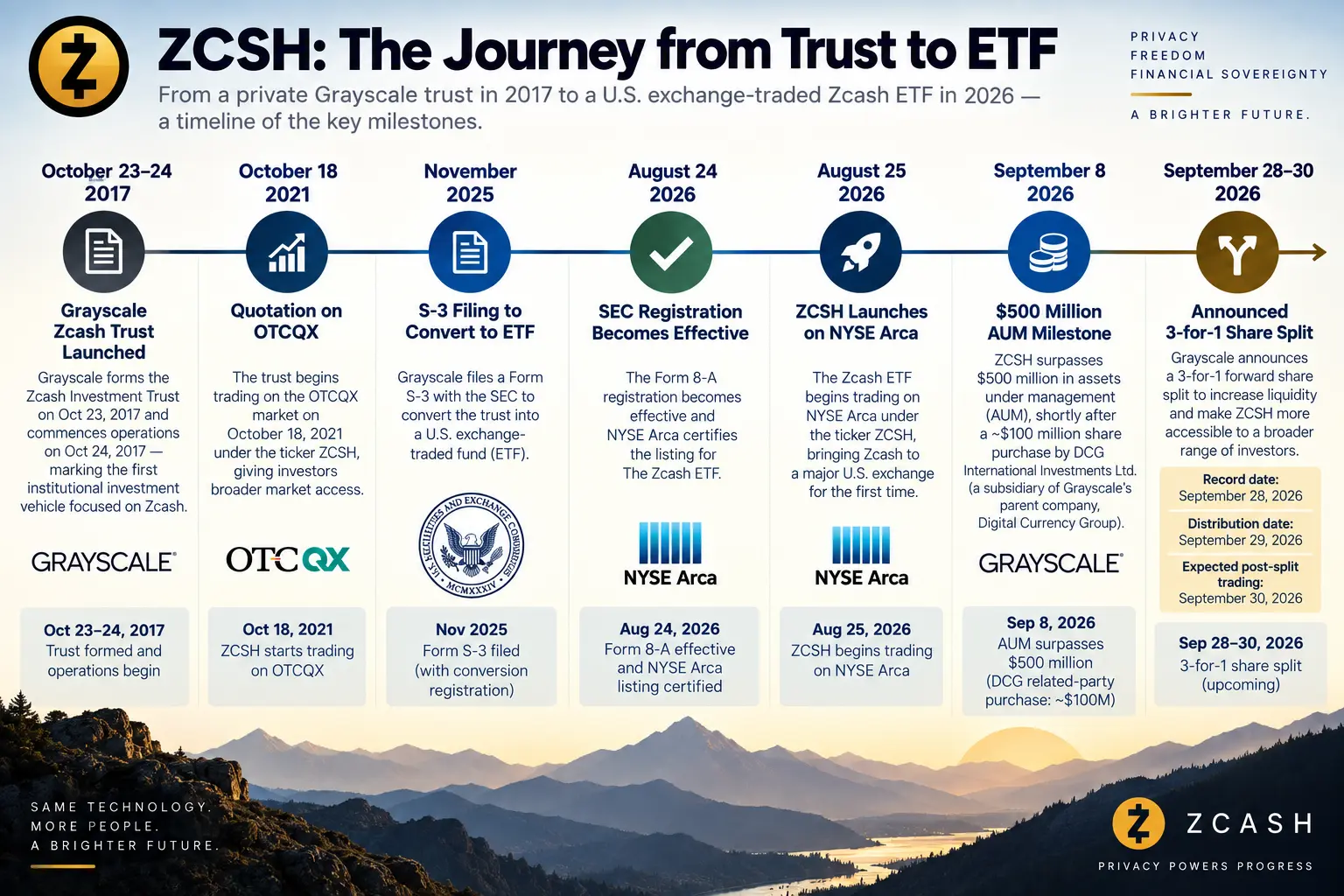
The trust was formed as a Delaware statutory trust on October 23, 2017, and commenced operations the following day. Its purpose then was the same as ZCSH's purpose now — giving investors exposure to ZEC without requiring them to buy and self-custody it — but the mechanism was entirely different.
There was no exchange listing and no public quotation of any kind. Shares were offered only through a private placement restricted to accredited investors under Rule 501(a) of Regulation D, issued periodically in exchange for ZEC contributed in-kind by those investors.
This matters for one reason in particular: much of the capital present when ZCSH moved to NYSE Arca in 2026 was already inside the trust years earlier. As of the trust's November 2025 conversion filing, it already held roughly $196.8 million in assets — before any exchange listing, before any "launch," and before the ZEC price rally that followed. Keep that figure in mind for the AUM discussion further down; it's the baseline the 2026 numbers actually grew from.
2021: ZCSH reaches the public OTC market
On October 18, 2021, the trust's shares were qualified for public trading on the OTCQX Best Market under the ticker ZCSH — the same ticker the NYSE Arca product uses today. This was a public quotation, not an exchange listing: OTCQX is a marketplace operated by OTC Markets Group, not a national securities exchange, and it didn't involve the kind of exchange listing process ZCSH went through in 2026.
That distinction turned out to matter a great deal.
The old problem: shares trading far from NAV
A fund's NAV (net asset value) reflects what its underlying assets are worth, net of liabilities. A fund's market price is simply what buyers and sellers agree to pay for its shares. In a well-functioning exchange-traded product, an arbitrage mechanism — market makers creating or redeeming shares — keeps those two numbers close together.
The OTCQX-era trust didn't have that mechanism in any continuous, efficient form. According to Grayscale's own SEC disclosures, between October 18, 2021 and June 30, 2026, ZCSH shares traded at a premium as high as 240% above NAV at times, and a discount as deep as 55% below NAV at others. A premium means investors paid more than the ZEC behind their shares was actually worth; a discount means the opposite.
That volatility in the price-to-NAV relationship — not ZEC's own price movement — is the specific problem the 2026 exchange-traded conversion was designed to fix.
November 2025 to August 2026: converting to an exchange-traded product
On November 26, 2025, Grayscale filed a Form S-3 registration statement with the SEC to convert the trust into a spot ZEC exchange-traded product listed on NYSE Arca. Several amendments followed over the next several months as the registration process continued.
Here's a distinction worth being precise about, because crypto coverage of ETF launches routinely gets it wrong: it is inaccurate to say "the SEC approved the Zcash ETF." The fund's own prospectus states plainly that the SEC has neither approved nor disapproved the securities, nor passed on the accuracy of the prospectus — that disclaimer is standard, required language, not boilerplate to skip past.
What actually happened is more specific. A Form S-3 registration statement becomes effective once the SEC's staff has no further comments (or once any comments are resolved) — that's a procedural clearance to sell registered securities, not a merit-based approval. Separately, the exchange itself — NYSE Arca — files its own listing application and, once satisfied, certifies the security for listing and trading on that exchange. Neither of those is "the SEC approving the fund"; they're two different institutions each completing their own, narrower process.
For ZCSH specifically: the trust's Form 8-A registration of its shares for exchange listing became effective on August 24, 2026, and NYSE Arca certified the listing the same day. The trust was renamed from "Grayscale Zcash Trust (ZEC)" to "The Zcash ETF" as part of that same process. Trading began the next day, August 25, 2026, making it — by Grayscale's own description — the first U.S. exchange-traded product to offer spot exposure to ZEC.
Did $300 million flow into ZCSH on launch day?
This is an easy number to misread, and it's worth being deliberate about.
ZCSH's NYSE Arca debut came with roughly $304 million in assets already associated with the fund (about 387,000–388,000 ZEC, based on figures reported around launch). That is not the same as $304 million of fresh investor money arriving on August 25, 2026.
The trust already existed. It already held ZEC — roughly $196.8 million worth as of the November 2025 filing (see above). ZEC's price rose substantially in the months between that filing and the August listing, which alone accounts for a large share of the AUM growth. The NYSE Arca transition changed how the fund traded and how new shares could be created — it didn't reset the fund's assets to zero and start over.
This is why it's worth keeping three different metrics separate, always:
- AUM (assets under management) — the total value of what the fund holds, at a point in time.
- Fund flows — money or ZEC actually moving into or out of the fund over a period.
- Trading volume — how many ZCSH shares changed hands on the exchange, which says nothing on its own about whether the fund grew or shrank.
Two weeks after launch, on September 8, 2026, Grayscale reported that ZCSH's AUM had crossed $500 million, alongside more than $70 million in cumulative inflows since the NYSE Arca debut. Those are two different, both genuine, figures.
The $100 million DCG transaction — and why the context matters
On that same day, Grayscale disclosed a separate transaction: DCG International Investments Ltd. acquired ZCSH shares valued at approximately $100 million, delivered through an Authorized Participant in exchange for 85,705.32563297 ZEC.
This transaction is real and well-documented — but it should not be read as an independent institutional investor's vote of confidence in ZCSH, because it isn't one. DCG International Investments Ltd. is a subsidiary of Digital Currency Group, Grayscale's own parent company. A purchase by a Grayscale affiliate is a related-party transaction, not third-party demand, and reporting the $500 million AUM milestone without that context overstates how much of the fund's growth came from investors independent of Grayscale itself.
For additional context: months earlier, while the ETF conversion was still pending, Grayscale's own filings disclosed a separate, larger, non-binding proposal under which a DCG contribution of up to 200,000 ZEC could have represented roughly 34% of the fund at that time. That specific proposal was not confirmed as executed at that size, and the fund has grown substantially since — so that 34% figure describes a pre-launch scenario under discussion, not DCG's actual current ownership share. We could not independently verify what percentage of today's larger fund the September 8 transaction represents, and we're not going to guess. What's verifiable is this: DCG, Grayscale's parent, is a documented, material holder of ZCSH shares, and that's worth knowing when evaluating headline AUM figures.
Also on September 8, 2026, options on ZCSH began trading on NYSE Arca — a separate development from the AUM milestone, giving investors exchange-listed tools to hedge or take positions on ZCSH itself.
What does ZCSH actually hold, and who runs it?
Per the fund's prospectus:
- Sponsor: Grayscale Investments Sponsors, LLC
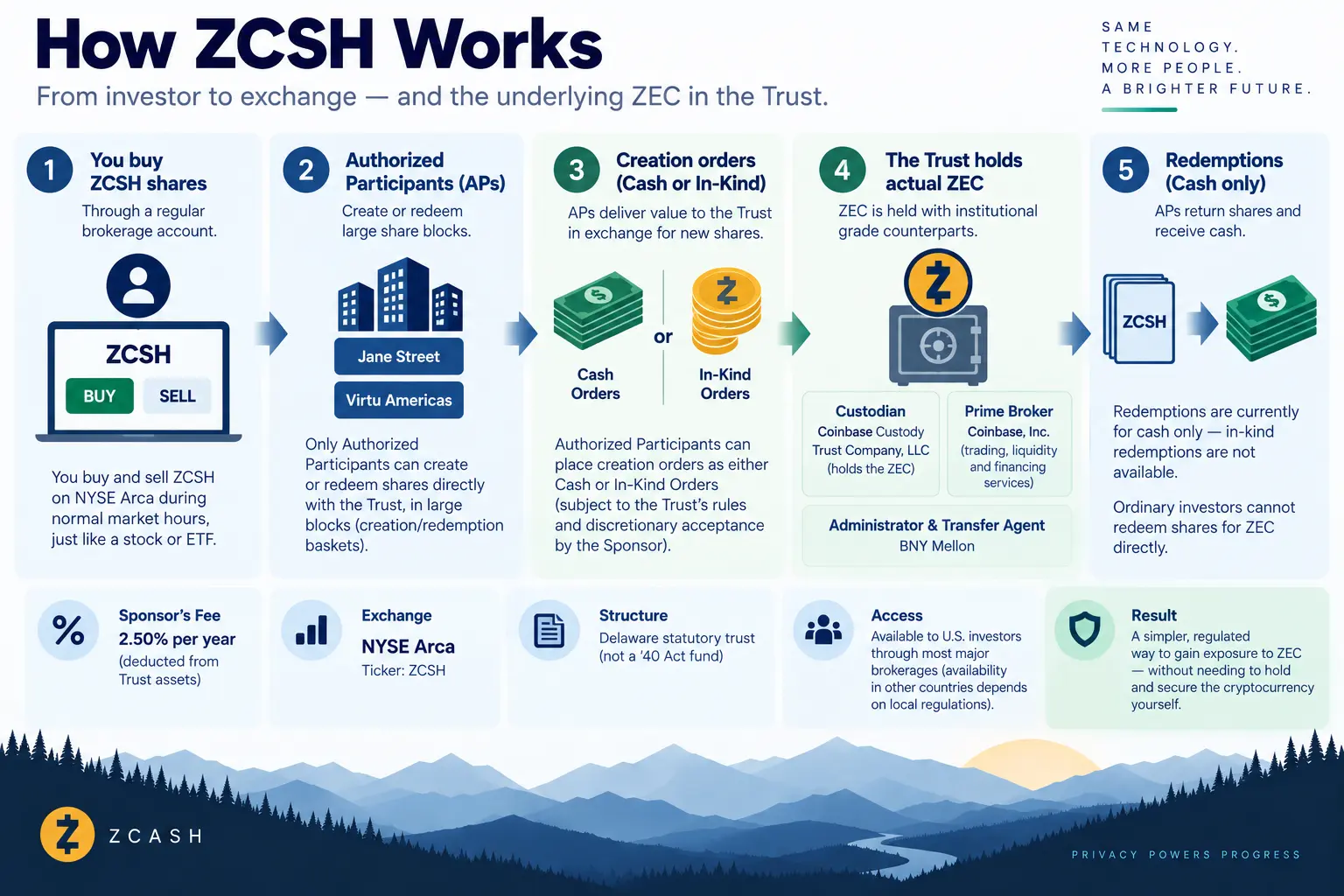
- Custodian: Coinbase Custody Trust Company, LLC — holds the actual ZEC and its private keys
- Prime Broker: Coinbase, Inc. — a separate role from the custodian, generally handling the fund's trading and liquidity relationships (executing purchases and sales of ZEC on the fund's behalf) rather than safekeeping the asset itself
- Administrator and Transfer Agent: The Bank of New York Mellon
- Underlying asset: ZEC, held directly
- Sponsor's Fee: 2.5% annually
- Valuation benchmark: the CoinDesk Zcash Benchmark Rate (the fund used the CoinDesk Zcash Price Index before April 1, 2026)
Custodian and Prime Broker are worth distinguishing because they're easy to conflate: the custodian is who actually holds the ZEC in cold storage, while the prime broker is who the fund transacts through when buying or selling ZEC. Both roles here are filled by Coinbase entities, but they're legally distinct functions.
The 2.5% Sponsor's Fee is a real, ongoing cost — for comparison, it's roughly ten times the expense ratio of most spot Bitcoin ETFs. Grayscale states that an amount equal to its management fee revenue supports Zcash ecosystem initiatives and ZCSH marketing; that's a stated allocation policy, not a fee waiver, and shareholders still pay the full 2.5% regardless of how Grayscale spends its share of it.
How creation and redemption work
Exchange-traded products like ZCSH rely on Authorized Participants — large financial institutions, in this case including Jane Street and Virtu Americas — to create and redeem large blocks of shares directly with the trust. That mechanism, not retail trading, is what keeps the market price close to NAV.
The mechanics are asymmetric. For creating new shares, Authorized Participants can place either Cash Orders or In-Kind Orders (delivering ZEC directly); the prospectus gives the Sponsor discretion to limit or cap Cash Orders on a given day, weighing factors like liquidity-provider availability and relative processing cost. For redeeming shares, however, only Cash Orders are permitted — the trust does not offer in-kind redemption to Authorized Participants at all.
Two things follow from this for an ordinary shareholder. First, none of this machinery is something retail investors interact with directly — you simply buy and sell ZCSH shares through your broker. Second, and more fundamentally: no ordinary shareholder, at any point in this process, can redeem individual ZCSH shares for the ZEC behind them. That capability doesn't extend past the Authorized Participant layer, and even there, it's a cash-only exit.
Creation and redemption procedures are governed by the Trust's current prospectus and related agreements and may be amended over time.
ZCSH vs. owning ZEC directly: what do you actually own?
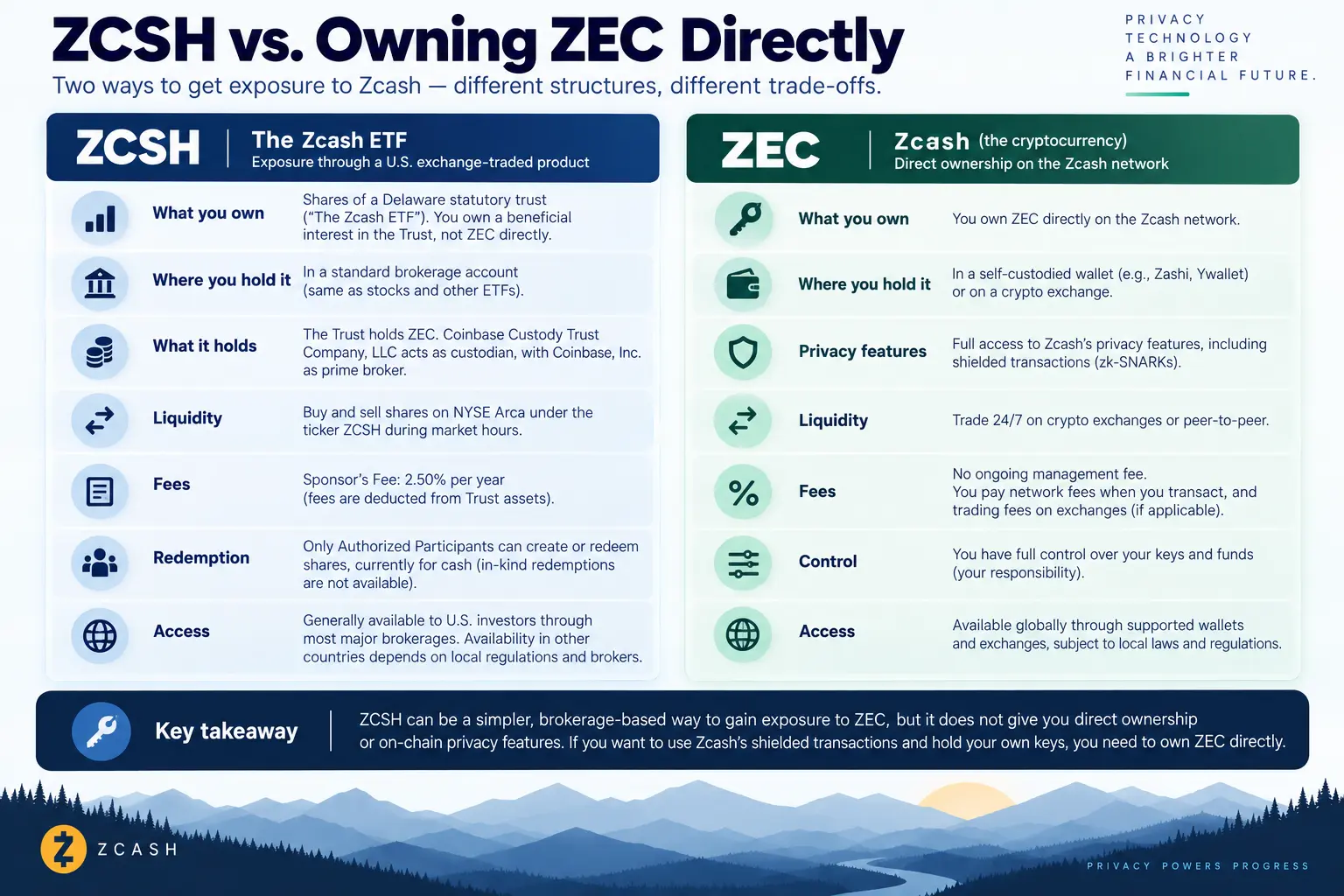
If you buy ZCSH, you own shares representing a beneficial interest in the trust. You do not receive ZEC in a wallet, you do not receive private keys, and you cannot send a ZCSH share over the Zcash network or use it to make a shielded transaction. You cannot, as an ordinary shareholder, exchange your shares for the proportional ZEC behind them.
If you buy ZEC directly, you own the asset itself. Holding it in a self-custodied wallet means you control the private keys, can transfer it over the Zcash network, and — with compatible wallet software — can use Zcash's shielded-transaction functionality. See our wallet guide if you're weighing self-custody options.
A few other practical differences:
- Trading hours: ZCSH trades during NYSE Arca's normal market hours; ZEC itself moves on a blockchain that runs continuously.
- Custody: ZCSH's ZEC is held by Coinbase Custody on the trust's behalf; direct ownership puts custody in your own hands (or whichever service you choose).
- Cost: ZCSH charges the 2.5% Sponsor's Fee described above; holding ZEC yourself carries no recurring management fee, only ordinary transaction and any exchange costs.
- Brokerage convenience: ZCSH fits inside a normal brokerage account, including tax-advantaged accounts where available; direct ZEC ownership requires a separate wallet or exchange relationship.
Neither is objectively "better" — they're different products serving different needs. But they are not interchangeable, and describing ZCSH as "owning Zcash" understates a real, legally significant difference.
Who can buy ZCSH?
In the United States, ZCSH trades on NYSE Arca and is generally accessible through any brokerage that supports the security — a major change from the trust's early years, when new shares were available only through a private placement restricted to accredited investors.
Outside the US, access is more complicated, and we're deliberately not going to state a blanket answer either way. European retail investors commonly cannot purchase US-domiciled exchange-traded products when the issuer hasn't produced the Key Information Document (KID) required under the EU's PRIIPs regulation — this is a general rule affecting most US ETFs, not something specific to ZCSH or to Zcash. The same substantive restriction applies to UK retail investors post-Brexit. Investors who qualify as "professional" under MiFID II generally fall outside that restriction. Actual availability also depends on your specific broker, which may apply its own policies on top of the regulatory baseline.
If you're outside the US, the honest answer is: check with your broker. "Anyone with a brokerage account can buy ZCSH" is not an accurate statement.
The 3-for-1 ZCSH share split
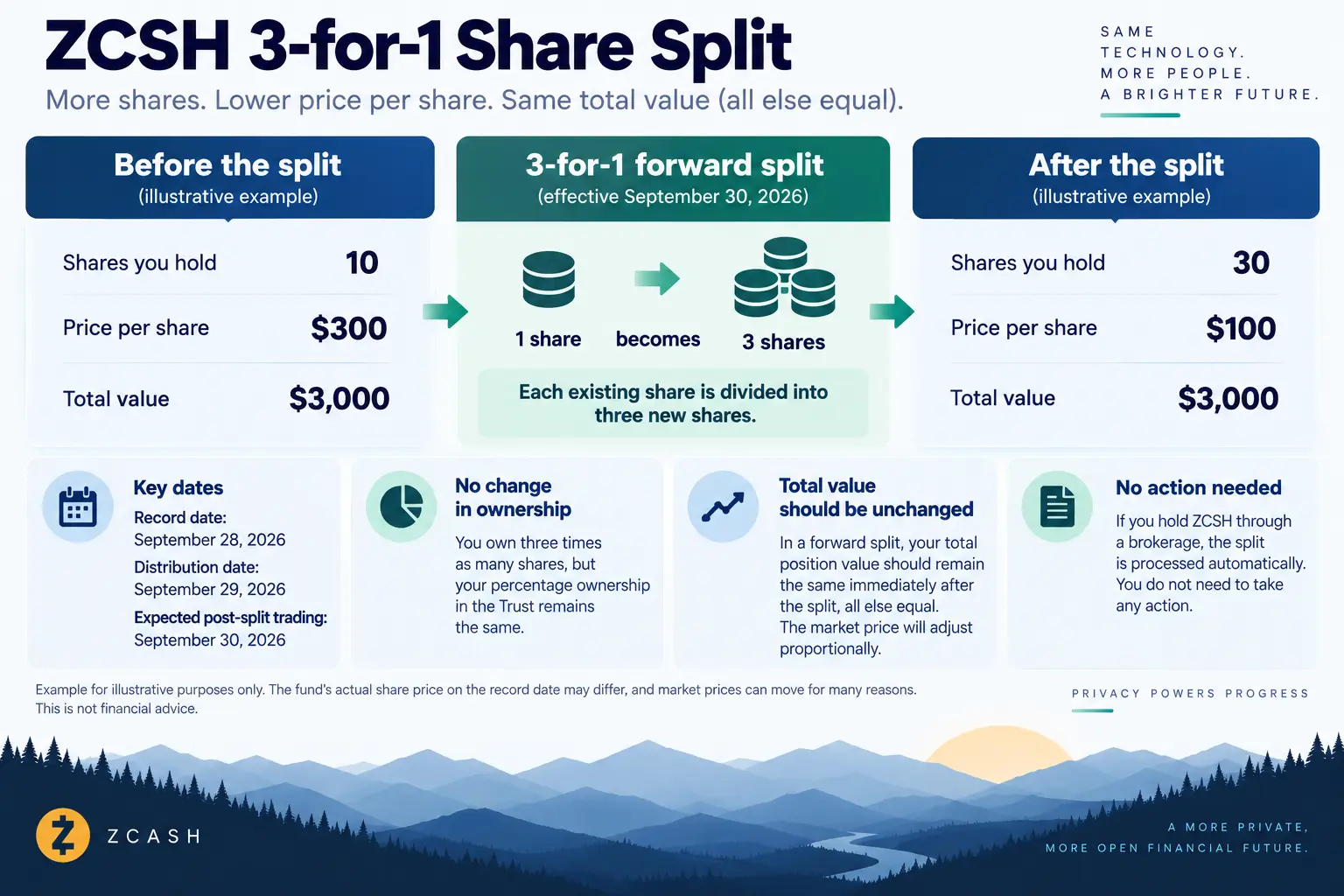
On September 18, 2026, Grayscale announced a 3-for-1 forward share split for ZCSH.
As of this article's last update (September 20, 2026), the split has been announced but has not yet taken effect. The schedule:
- Record date: September 28, 2026
- Payment date: September 29, 2026
- Expected first day of split-adjusted trading: September 30, 2026
Shareholders of record on the record date are expected to receive three post-split shares for every one pre-split share they hold. The ticker (ZCSH) and CUSIP are expected to remain unchanged.
A forward split is a mechanical adjustment, not a value-creation event. It changes the number of shares outstanding and the price per share; it does not, by itself, change the total value of an existing position or the amount of ZEC backing the fund.
Purely illustrative example (not the fund's actual price on any specific date):
Before the split: 10 shares × $300/share = $3,000 total. After a 3-for-1 split: 30 shares × $100/share = $3,000 total.
Same total value immediately after the split, all else being equal — more shares, each representing proportionally less value, with the fund's total ZEC holdings unchanged.
Why this history matters
ZCSH's most interesting feature isn't that a Zcash product reached NYSE Arca — it's that the same investment vehicle spent nearly nine years evolving into that point. It began as a private trust serving accredited investors in 2017, gained a public OTC quotation in 2021 that came with years of large, sometimes extreme, price-to-NAV gaps, and only became a continuously-traded exchange product in 2026 — at which point that price-to-NAV problem largely resolved.
The distinction that matters most for anyone evaluating ZCSH is simple: it provides economic exposure to ZEC's price through the traditional brokerage and securities system. It does not provide ZEC itself, or any of the functionality — sending, receiving, shielding — that comes with actually holding it.
Zcash ETF FAQ
Is there a Zcash ETF? Yes. The Zcash ETF trades on NYSE Arca under the ticker ZCSH, is sponsored by Grayscale, and holds ZEC directly.
When did the Zcash ETF launch? ZCSH began trading on NYSE Arca on August 25, 2026. The underlying Grayscale Zcash Trust dates back to October 2017.
Does ZCSH actually hold ZEC? Yes. The fund's purpose is to hold ZEC directly, custodied by Coinbase Custody Trust Company, LLC.
Is buying ZCSH the same as buying ZEC? No. ZCSH gives you shares in a trust that holds ZEC; it doesn't give you the ZEC itself, private keys, or the ability to transact on the Zcash network.
Can I withdraw ZEC from ZCSH? No — not as an ordinary shareholder. Even Authorized Participants can only redeem ZCSH shares for cash, not ZEC, under the fund's current mechanics.
What does ZCSH cost? A 2.5% annual Sponsor's Fee.
Who custodies ZCSH's ZEC? Coinbase Custody Trust Company, LLC. Coinbase, Inc. separately serves as the fund's prime broker.
Why did ZCSH shares once trade at such large premiums or discounts? Because the pre-2026 OTC-quoted trust lacked the continuous creation/redemption mechanism that keeps an exchange-traded fund's price close to NAV. Grayscale's own filings disclose premiums as high as 240% and discounts as deep as 55% between October 2021 and June 2026.
Is ZCSH available in Europe or the UK? It depends on your broker and investor classification. US-listed ETFs, including ZCSH, are generally unavailable to EU/UK retail investors under PRIIPs documentation requirements, though professional investors are typically unaffected. This isn't Zcash-specific — it applies broadly to US ETFs sold into Europe.
Has the ZCSH 3-for-1 split happened yet? Not as of this article's last update (September 20, 2026). It was announced September 18, 2026, with a September 28 record date and split-adjusted trading expected to begin September 30, 2026.
Does the split make shareholders richer? No. A forward split increases share count and proportionally lowers the price per share; it doesn't change the total value of an existing position.
For live ZCSH figures — current AUM, NAV, net flows and premium/discount — see the ZCSH ETF Tracker. This article covers history and mechanics; treat the numbers above as dated milestones, not current figures.
Sources
This article draws primarily on SEC filings and Grayscale's own disclosures, cross-checked against multiple independent financial and crypto-industry sources where a primary filing could not be directly reviewed:
- SEC EDGAR — Grayscale Zcash Trust filer page (CIK 0001720265)
- SEC EDGAR — Form S-3, filed November 26, 2025
- SEC EDGAR — Form 424B3 prospectus, August 25, 2026
- SEC EDGAR — Form 8-K, August 21, 2026 (rename announcement)
- SEC EDGAR — Form 8-K, September 8, 2026 (AUM milestone / DCG transaction)
- SEC EDGAR — Form 8-K, September 18, 2026 (3-for-1 split)
- Grayscale — official ZCSH product page
- GlobeNewswire — OTCQX quotation announcement, October 18, 2021
- GlobeNewswire — NYSE Arca trading begins, August 25, 2026
- GlobeNewswire — $500M AUM milestone, September 8, 2026
- GlobeNewswire — 3-for-1 share split announcement, September 18, 2026
This article is for informational purposes only and does not constitute investment, legal, or tax advice. ZecZcash is an independent Zcash community site and is not affiliated with Grayscale, DCG, Coinbase, or NYSE Arca.
Get every update the second it's posted
Join ZecZcash, our independent Zcash community on Telegram, for real-time news, price talk and discussion.
Join @ZecZcash on Telegram